What are the purpose of doors? Some examples are: for access, to protect a space, to open and close a space. A door can be a very important design feature and should always be considered before walls, to allow for suitable gap dimensions, framework and surroundings. Also, pay attention to which way a door hangs, clockwise, or anticlockwise. A buildings’ doors should follow the same design theme throughout, paying particular attention to choice of hinges and fixings. Hardware is like the jewellery of a home and there are many material choices available, for example, aluminium chrome finished and polished nickel.
We discussed unique entry points which make for a ‘wow’ first impression. No transition from the outside to inside, creates an elegant flow of material. Entrance doors can either blend in or stand out. The standard opening is 2040 x 2100mm. Widths can vary from 626, 726, 826 and 926mm. This is of course not set in stone, though it is better to scale up rather than down for practicality and access purposes. The depth of a door also varies; whereas a fire door might be 44mm, an interior door may be narrower.
A solid core door is good for sound proofing and generally the best choice overall. When using solid timber around the perimeter it is easy to shave off from the top or bottom, to achieve the perfect fit. Mdf is a cheaper option that looks clean and crisp. It can also be clad or painted easily. Architrave is the decorative moulding surround, which conceals any mess in the gaps where the door is to be positioned. Door sets are available to buy pre-assembled, including both the door and the frame.
Door components: Door closer, lever set, push plate, pull handle, signage, escutcheon (eye hole cover), cylinder (lock), kick plate, doorstop (floor or wall mounted), vision panels.
Thresholds can change the floor surface from inside to outside, leading to a change in floor levels, as well as a possible change in rooms. When laying carpet it is aesthetically much better to lay straight through, with no visible threshold.
When drawing floorplans it is wise to use notations. Each door should be numbered e.g. D3, relating to a door schedule. Annotation is to include the door type, size, what door furniture is to be used, which way the door is to open, fire rating category, any signage, painted, hinge, etc.
With regards to legislation, nothing is allowed to be positioned within a metre of a door. Therefore, as an interior designer, it is wise to draw a metre around a doorway in the plans to be on the safe side. These can always be deleted afterwards.
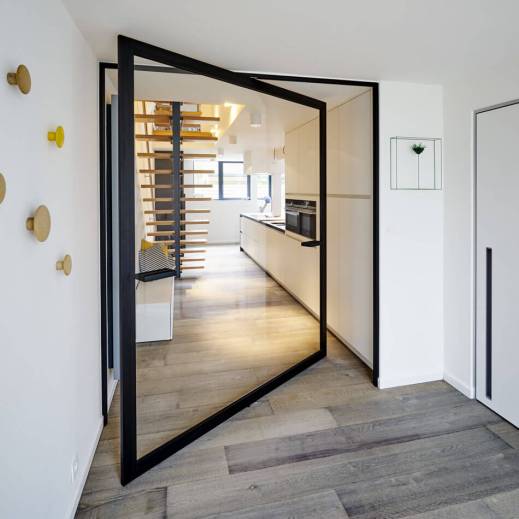
Above is a door by Belgian brand ‘Anyway Doors’. It revolves from a central pivot hinge, which is fully integrated and seamless to the eye. It also has a patented silent closure system, which eludes to a lightweight door.
During the lecture we talked about windows and various openings. Windows allow for a view to be seen from within a building, as well as letting in daylight, which enhances a space. They can be used internally to define a space, as well as to add interest. There are many different types of windows and numerous ways in which they open Some examples are: bay, oriel, skylight, casement, hopper, mulled, to name a few. When drawing windows in floorplans you must show which way the window opens, by indication of where the hinges are positioned. As well as including a window schedule, similar to that of doors.

