In this second lecture we discussed walls and how they can be used to divide or define a space. Typically this means walls from floor to ceiling but it needn’t have to.
There are load-bearing internal and external walls, as well as non load-bearing ones. We looked at the various components which make up different types of walls, including cavity insulation, spacers, concrete blocks, waterproof membrane, bricks and mortar joints. Wall ties are critical for holding a wall together and upright, otherwise cracks will appear horizontally. The benefit of plastic ones mean that they don’t break or deteriorate. It is possible to build for longevity if the materials are carefully considered.
We were shown ‘crushed wall’ by Walter Jack Studios. Located at Heartlands, Redruth, Cornwall. It was made by pouring liquid concrete into a series of moulds, which were then connected. The designer wanted to ‘retain the liquidness of the process’ despite concrete becoming a solid form.

‘crushed wall’ Walter Jack Studios.
We touched on brickwork and the numerous patterns with which can be configured. For example, English bond is where the bricks alternate courses of headers and stretchers, to give a heritage appearance. Headers being the shorter width edge and stretchers the length edge. This is considered to be the strongest bond and can be used for walls of all thicknesses. Brickwork can bring a fun and creative element to the overall design of a building. Some designs appear to be more favourable that others at this time.
A standard bricks dimensions are 215mm length x 102.5mm width x 65mm depth. When you know this it becomes possible to estimate the height of a building, simply by counting the number of bricks.
When using brickwork you must allow for water penetration from the rain by incorporating a waterproof membrane, as well as an overhanging roof. It is useful to know that planning offices are very favourable of brickwork buildings in this country.
Prior to the introduction of plasterboard, the walls of heritage buildings were constructed using plaster and lath. This is a mixture of lime, plaster and horsehair, spread over a lath wood framework. Today this would be expensive to reproduce, which can be problematic when required to repair a heritage property for preservation. It is also susceptible to water penetration and moisture issues and will require a skilled professional to carry out any maintenance.
Plasterboard walls should be constructed with vertical studs (verticals) spaced 600mm apart, beginning from the centre. Horizontal studs (noggins) should be offset, to allow access for nailing in from the sides. There is also a header at the top and a sole, or base plate, at the bottom of the framework. Stud walls should be spaced 600mm apart in order for the jip rock (plasterboard) to fit. Scrim tape is used to conceal plasterboard joints and a filling compound for screw holes. The edges of plasterboard are tapered for joining purposes. Expanded metal angle beads used for corners. British Gypsum is the UK’s leading manufacturer of interior lining systems.
A shadow gap can be used both at the top of a wall and at its base. Instead of skirting or coving used to conceal the join to floor or ceiling, a gap is left. LED lighting could also be incorporated here to highlight or enhance a space.
 Example of a shadow gap.
Fire resistance is another important feature to consider in regards to walls. A non load-bearing partition, with a single layer of plasterboard both sides, and a skim coat, would withstand a fire for approximately 30 minutes. Some thicknesses allow for 60 minutes resistance or more.
There is also the option for metal studwork as opposed to wooden. Plasterboard can be configured in a brick work pattern over much larger areas, using special guns for attachment. There is a higher cost for this method, although time wise it is much quicker, allowing for faster construction. It is also cleaner and reusable.
We covered partition walls, important for soundproofing within office spaces. Glass walls are a good option for creating openness, as too are moveable glass partitions. There are many ways in which walls can be creative and adaptive, such as pivoting timber panels, which lock to create walls, and slatted walls allowing for fittings and fixtures to be slotted into or attached. A simple wall of hooks creates endless possibilities for both purpose and the aesthetics of a space.
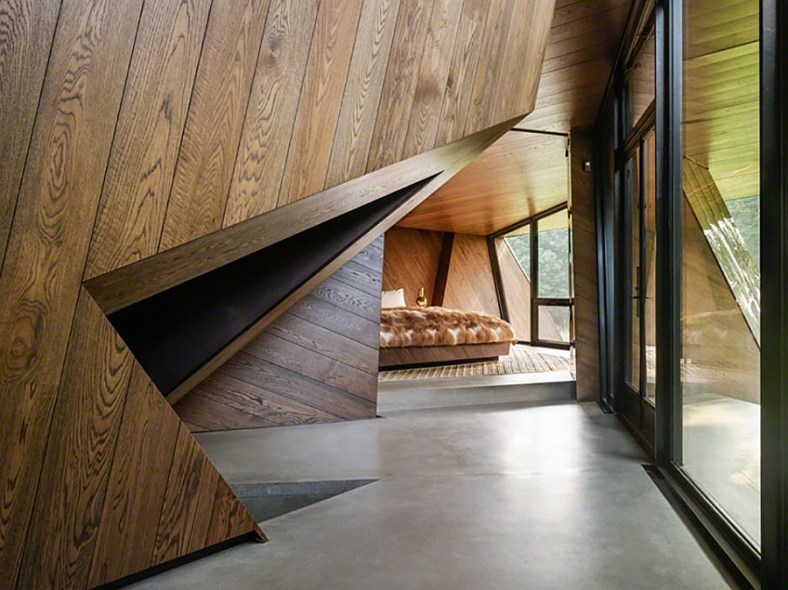
Western Connecticut house by Daniel Libeskind.
I chose this example to illustrate how walls can creatively configure a space. It’s use of wood panelling throughout adds to the aesthetic cohesion.
 my design soup