Over the past 20-30 years the bathroom has become less of a functional space and more of a retreat/sanctuary. They have grown in size and the design has also improved dramatically.
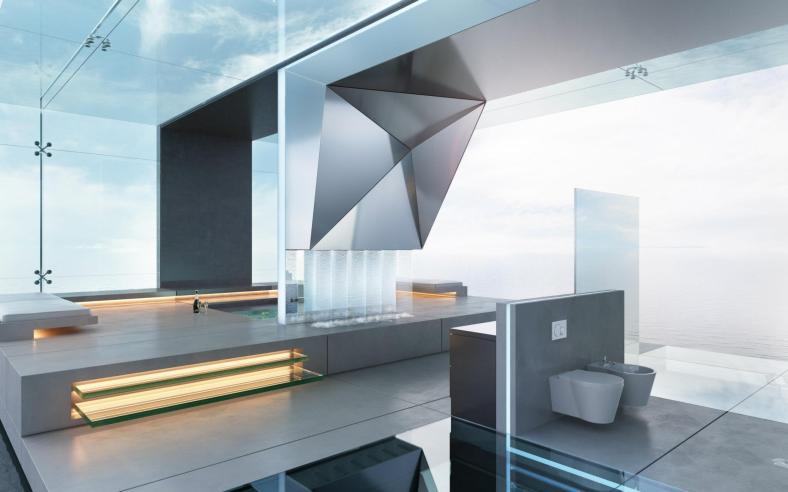
When designing a bathroom it is vital to plan ahead, in order to allow for necessary plumbing. An important consideration might be, whether or not to have an inbuilt cistern toilet. In which case a back panel with the flush is required and access to the cistern. A wall mounted toilet, which appears to be floating off the ground, is cantilevered from a steel frame in the wall. This creates more space within the bathroom and is also more hygienic for cleaning purposes.
Mains flush toilets are used more frequently in commercial buildings. They have no cistern, instead a remote pump which pumps to toilets. Having at least five toilets makes this both cost effective and water efficient.
If the client specifies floor mounted taps for a bath, they will need to be laid in the floor before the concrete is poured.
Lighting also needs to be planned well in advance.
Marble – available in sheets 1200 x 2400, 18-20mm thick. Book matched means the veins line up, whereas slip matched they don’t. It’s important to tell the stone mason which one you want for the job. Carrera marble comes from Italy and Calcutta form India. A raw slab costs approximately £300. The expense is in the masonry labour. Marble stains easily and is hard to clean.
Granite – is much harder and more practical than marble. A very hard, granular, crystalline, igneous rock consisting mainly of quartz, mica, and feldspar.
There are a number of different stone profiles and edging treatments available; Mitred, 1/4 bevel, ogee, full bull nose, shark nosed, half bull nose. Mitred is ten times more expensive than pencil round.
 my design soup