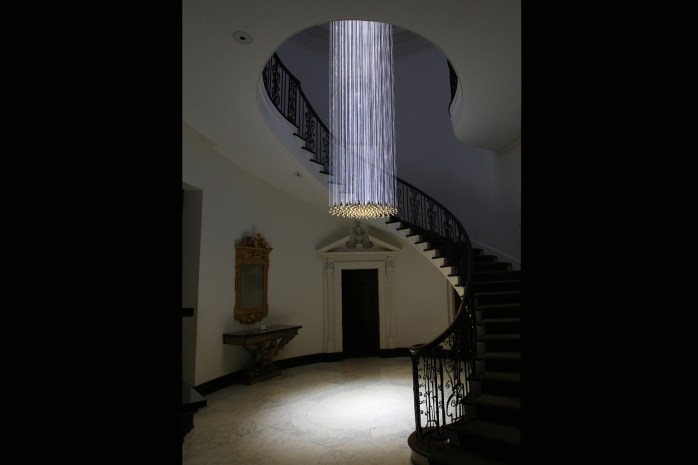
Bruce Munro_
One of the most important tools of an interior designer is lighting. It can help to transform the way we feel about a space. Lighting can usually be split into three categories; ambient, task and accent.
Ambient – Lighting the entire room for use, e.g. fluorescent lighting.
Task – Performs a task, e.g. a desk lamp.
Accent – Lights something in particular, e.g. directed onto a picture.
Some lighting systems accommodate all three types. It is possible to create different effects such as moody, functional, decorative, sophisticated, architectural, feature. Though it is important not to mix different colour temperatures within the same space.
LEDs have become increasing popular and allow for colour affects within spaces. It is well known that different colours can affect how a person feels, so this is an important consideration for an interior designer.
Even white light comes in varying tones, such as warm, soft yellow or blue white. A warmer white is considered most welcoming. Natural daylight must also be appreciated and taken into account.
We looked at examples of lighting plans and what they might include. A nightclub, for example, might use a back lit Corian bar, illuminated tables, feature lights, down lighters, pendants, etc. As an interior designer it is crucial to document all services on a lighting plan. This helps the builders to accommodate the design at installation stage.
In a bathroom the best possible lighting comes from in front of a mirror, or around the peripheral, and ideally diffused. This is an ideal set up for women to apply their makeup, or for men shaving. Some source of natural light in a bathroom is also hugely beneficial.
Dimers control the amount of light within a space and can serve to alter the mood of a room instantaneously. Lighting must ideally be controllable, otherwise you risk over lighting a space, which can become too harsh or stark.
Consider lighting through spaces. What will it look like from outside? Lighting a tree outside can be viewed and appreciated from inside. Think creatively!
Lamp – technical term for a lightbulb.
Downlights only project a distance of 1.5m from the ceiling. Therefore alternative lighting sources would need to be used in a space with high ceilings.
A glossy floor reflects low level LED strip, which is unattractive. A solution would be to specify a matt flooring, which creates a softer, diffused glow instead.
A reflected ceiling plan (RCP) is used to communicate a lighting plan. It is drawn from above, looking down. The key and legend on the drawing are the most important part of any plan as it enables readers to determine exactly what is what and what goes where. A different symbol must be used for every different type of lighting, to avoid any confusion. The key can be positioned anywhere on a drawing as long as it is on the drawing and not a separate document.
Consider the positioning of switches. Two way switches. The height of light switches.
Smart home automation is very big nowadays and more and more people are installing it, as opposed to traditional wiring of a switch to a light. This allows people to control the lights and sound within their property, via an iPhone, or a control panel on a wall. An interior designer would design the concept drawings but would not be expected to do the lighting plans in these instances. Phillips have the best looking fittings for these types of systems.
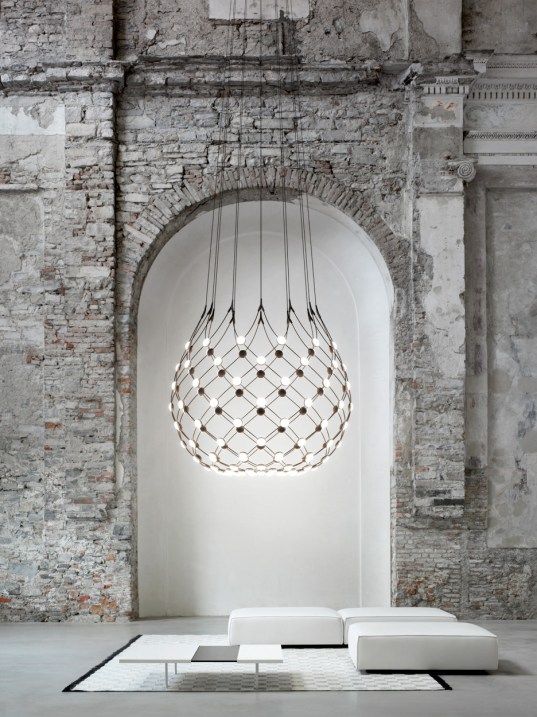
‘Mesh’ by Francisco-Gomez-Paz
Lighting can make or break a space!
 my design soup