We are lucky enough to have Charles Baxter of Baxter Creative teach a series of lectures over the coming weeks. I’m excited to learn more about the fundamentals of structures, as this will bring a very real element to my design process.
In this first lecture we discussed what keeps a building intact? It is in fact an arrangement of interrelated elements. There are usually structural walls on the outside of a space, defining an area. As designers we should look to understand how buildings are supported and held up. There is a load carrying part in all natural and manmade forms, and even temporary structures require structural supports. It is therefore essential to have an understanding of loads and forces to fully understand a structure.
Forces come in many guises. We were shown examples of each of the following, but here are the basics:
Compression – force pressing downwards, i.e. the force of a lintel.
Tension – weight pulling down on an object.
Imposed load – removable load, often a user load i.e. people walking over a floor.
Dynamic load – induced by varying external conditions.
Thermal load – effect temperature has on a structure.
As far as materials go, masonry is excellent in compression. Timber is good in both compression and tension. Steel is excellent in tension, though weaker in compression.
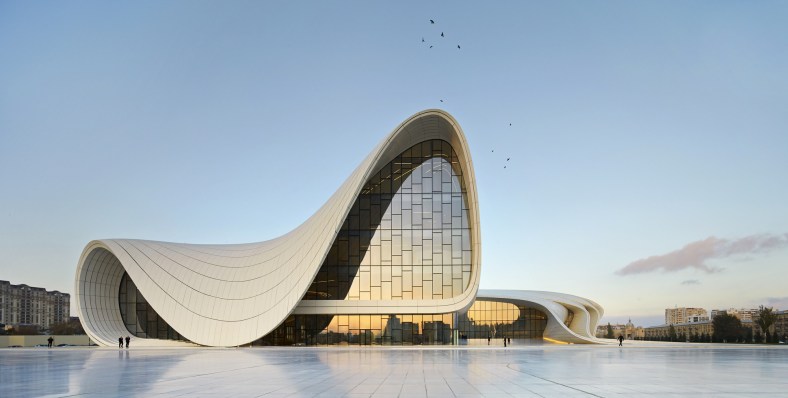
The Heydar Aliyev Center, Baku, Azerbaijan. ZH Architects, 2013.
When I first saw a photo of this building it blew my mind. I couldn’t fathom how Hadid had come up with the design, let alone begin to contemplate the logistics of its construction. It is understood that she approached structures by looking to both science and design.
Further research revealed that the Heydar Aliyev center consists of two coactive systems, a concrete structure combined with a space frame system. The space frame system allowed for the construction of a free form structure, saving valuable time during the construction process. The substructure was designed to incorporate a flexible relationship between the rigid grid of the space frame and the free form exterior cladding seams.
It is the role of structures to create awe and wonder. We only need to look at cathedrals to see evidence of this, and other structures, spanning throughout history. I am personally very interested in this element of design and how buildings can elevate human feelings.
 my design soup